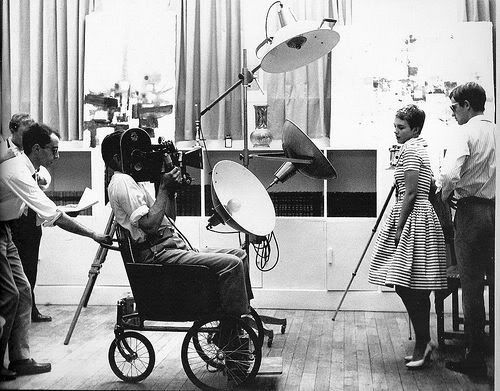
The scale of it looks remarkably similar to what’s often called “no-budget” filmmaking now-a-days, no? Camera’s about the size of an EX3. Lit by household lamps. Director pushing a wheelchair for the “dolly”.
And well shit, while I’m waxing authoritative about indie filmmaking and
A bout de souffle (and I know most of you already know, but for those who don’t, the english title is “Breathless” and it’s mandatory viewing for artsy fartsy film snobs like us), here’s an already widely known tidbit that I’ll hereby take heroic credit for spreading a teency weency wider.
The filmmaker pictured above, Jean-Luc Godard, was a film critic before he made movies. He and a bunch of other thinker/writer/cineastes upkept a periodical called
Cahier du cinema. Nowadays, historians tend to attribute these guys with beginning to convince the world that film was not mere pulp and circus but was indeed a form of art.
The story continues that one day, some filmmaker who had perhaps received some negative criticism from the
Cahier, or perhaps not, I don’t really know, I’m half making this up, put the question to them. If you guys have so much to say about movies, why don’t you make some yourselves?
So they did. Of course, they didn’t have the resources had by the standard filmmaking endeavors of the day. But they didn’t try to imitate the glossy look of Hollywood’s golden age. Instead, they embraced their limited resources and created what everyone now calls the “New Wave” that spread out into the crop of American masterpieces in the late 60s and 70s — Raging Bull, Badlands — all the way into the “Independent” movies of the 90s — Pulp Fiction, Sling Blade.
It seems to me that this is a pertinent story to tell here among the internauts for a couple reasons. First is the obvious analogy of adapting limited resources into a new genuine aesthetic rather than imitating the established one. Second, there sure are a lot of critics online. Now writing comments about movies and videos is cool and all. But for my bet, RECords are way more fun to make than Remarks.

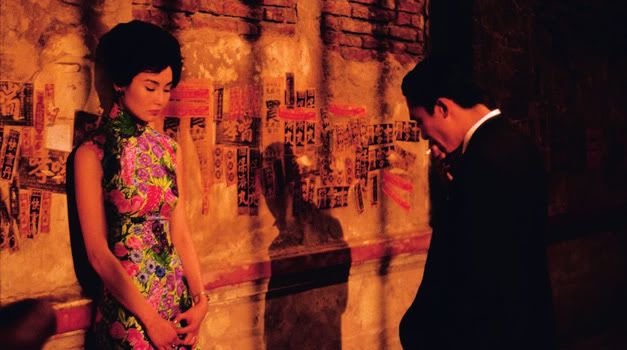 in the mood for love / 花樣年華 (2000), directed by Wong Kar Wai (王家衛).